
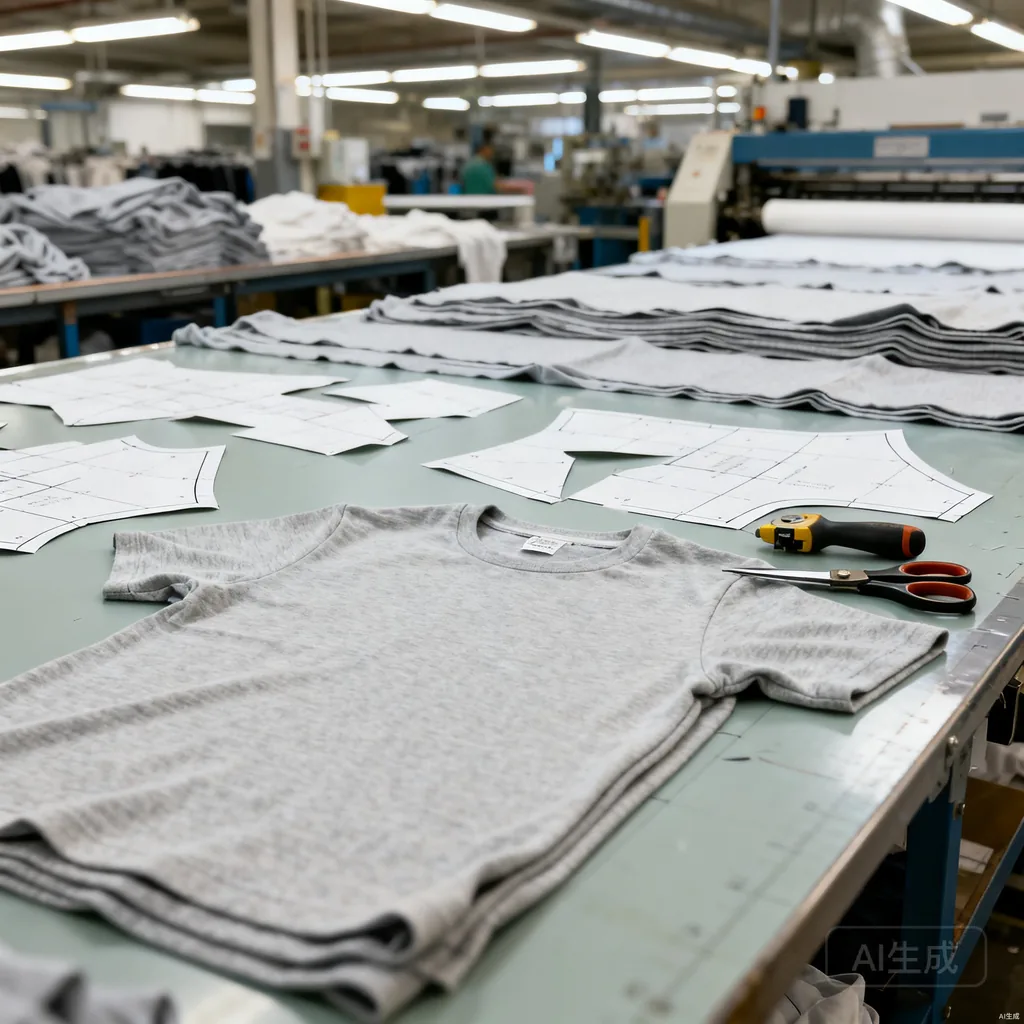
Ever wondered how a t-shirt manufacturing process works from raw cotton to finished garment? This guide walks you through every step of production.
Step 1: Fabric Sourcing and Inspection
Fabric is sourced from certified mills. Upon arrival, every roll is inspected for weight (GSM), color consistency, shrinkage rate, and defects. Fabric that fails inspection is rejected before any cutting begins.
Step 2: Pattern Making and Grading
Patterns are created based on the garment design and size chart. Each size (S, M, L, XL, etc.) gets its own pattern piece. Modern factories use CAD software for precision.
Step 3: Cutting
Fabric is laid in multiple layers on a cutting table (up to 100 layers high). Computer-controlled cutting machines ensure precision and minimize waste. Cut pieces are sorted by size and color.
Step 4: Printing or Embroidery (if applicable)
Pieces that need printing are sent to the print room. Screen printing, DTG, or DTF is applied before assembly for flat-panel printing.
Step 5: Sewing and Assembly
Cut pieces are sewn together on industrial sewing machines. A typical t-shirt goes through 5-8 sewing operations: shoulder seams, sleeve attachment, side seams, neckline binding, and hemming.
Step 6: Quality Control
Every finished garment is inspected for: stitching quality, seam strength, print accuracy, size measurements, color consistency, and overall finish. Defective pieces are rejected or reworked.
Step 7: Finishing and Packaging
Garments are steamed/pressed, labeled (neck tags, size labels, care labels), folded, and packed into poly bags according to the packing specification.
Step 8: Shipping
Packed garments are boxed, labeled, and shipped via air (5-8 days) or sea (25-35 days). DDP shipping handles all customs and duties.
Timeline
The entire process from order confirmation to delivery typically takes 20-40 days depending on order size and shipping method.
Conclusion
Understanding the t-shirt manufacturing process helps you make better decisions as a brand owner. Start your production with our experienced team.
Detailed Production Timeline
A typical custom t-shirt order takes 30-50 days from fabric sourcing to final inspection. Here is a day-by-day breakdown of what happens at each stage.
| Stage | Days | What Happens |
|---|---|---|
| 1. Yarn sourcing and knitting | 5-8 days | Cotton yarn is sourced, tested, and knitted into fabric rolls on circular knitting machines. |
| 2. Fabric finishing | 3-5 days | Fabric is scoured, bleached, dyed, and finished to spec (pre-shrunk, mercerized, etc.). |
| 3. Fabric inspection | 1-2 days | 4-point system inspection for defects, weight verification, and color matching against approved lab dip. |
| 4. Pattern making and grading | 2-3 days | Patterns are created or adjusted based on your tech pack, then graded into all required sizes. |
| 5. Sample production | 3-5 days | Pre-production samples are made for your approval before bulk cutting begins. |
| 6. Bulk cutting | 2-4 days | Fabric is laid in layers and cut with computer-controlled or manual cutting machines. |
| 7. Sewing and assembly | 10-15 days | Cut pieces are sewn into finished garments. Side seams, sleeves, collar, and hem are stitched. |
| 8. Printing or embroidery | 3-5 days | Decorative elements are applied based on your specifications. |
| 9. Quality control and inspection | 1-2 days | Each garment is inspected for stitching, print quality, sizing, and overall appearance. |
| 10. Finishing and packaging | 1-2 days | Garments are folded, polybagged, and packed into cartons with proper labeling. |
| Total | 30-50 days | From yarn to finished, packed, and ready-to-ship t-shirts. |
Quality Control Checkpoints
A reliable factory has quality control built into every stage, not just at the end. The five key QC checkpoints are: incoming fabric inspection (check weight, color, defects), in-line inspection during sewing (check seams, sizing, alignment), pre-printing inspection (verify placement and color), final inspection (AQL-based random sampling), and pre-shipment inspection (carton-level check).
For orders above 1,000 units, we strongly recommend hiring a third-party inspection company like SGS, Bureau Veritas, or QIMA to perform a pre-shipment inspection. Cost is typically $200-400 per inspection and can save you from receiving a shipment of defective goods.
Common Production Issues and How to Avoid Them
The most common production issues are: color shift between lab dip and bulk production (avoid by approving lab dip under D65 light box), shrinkage beyond 3% (avoid by requesting pre-shrunk fabric and verifying with a wash test sample), inconsistent sizing across sizes (avoid by using graded patterns from a single base size), print misregistration (avoid by approving print strike-off before bulk), and packaging damage (avoid by using proper carton dimensions and inner packaging).
Frequently Asked Questions
How long does a sample take?
A pre-production sample takes 7-10 days after artwork and tech pack are finalized. This includes pattern making, sample sewing, and shipping to you. Express shipping adds 3-5 days.
Can I change the design after production starts?
Changes are possible up to the fabric cutting stage. After cutting, changes are very expensive (essentially starting over). We recommend finalizing all design elements, including print placement, label position, and packaging, before approving the pre-production sample.
What is a tech pack?
A tech pack (technical package) is a detailed document that includes all specifications needed to manufacture your t-shirt: measurements for each size, fabric specifications, color references (Pantone), print or embroidery details, label and tag placements, packaging requirements, and quality standards. The more detailed your tech pack, the fewer surprises during production.
What is AQL?
AQL stands for Acceptable Quality Level. It is a statistical sampling standard used in quality control. AQL 2.5 means that in a random sample, up to 2.5% of items can have defects and the batch is still acceptable. For custom apparel, AQL 2.5 for major defects and 4.0 for minor defects is industry standard.
Quality Control Checkpoints Throughout Production
Quality control is not a single step; it is a continuous process embedded throughout manufacturing. The five critical QC checkpoints are: (1) incoming fabric inspection, where the fabric is checked for weight, color, weave consistency, and defects before cutting; (2) in-line inspection during sewing, where inspectors check stitching, sizing, and assembly at regular intervals; (3) pre-printing inspection, where the blank garment is checked for any defects introduced during cutting and sewing; (4) post-printing inspection, where the print quality, placement, and curing are verified; and (5) final inspection before packing, where the finished garment is checked against the approved sample for color, sizing, construction, and overall appearance.
At OEM T-Shirts, our QC team performs inspections at each of these checkpoints using AQL (Acceptable Quality Level) sampling standards. For most orders, we use AQL 2.5 for major defects and AQL 4.0 for minor defects, which is the industry standard for custom apparel. For premium or large orders, we can tighten to AQL 1.0 / 2.5 at additional cost.
Lead Times and Production Planning
Standard lead time for custom t-shirt production is 15-25 days for sampling, 25-40 days for bulk production after sample approval, and 25-40 days for sea freight to North America or Europe. Total time from initial inquiry to receiving your order is typically 10-14 weeks. Rush production is available for an additional 20-50% surcharge and can reduce bulk production time to 10-15 days, but is only recommended for urgent situations because it increases the risk of errors and quality issues.
For seasonal collections, we recommend starting the design and sampling process 4-5 months before your target launch date. This gives you time for sample iterations, bulk production, shipping, warehousing, and marketing launch. Brands that try to compress this timeline usually end up with quality problems or stockouts during the critical first weeks of sales.
Factory Tour and What to Look For
If you visit a factory in person, here is what to look for. Cleanliness and organization are the first indicators of a well-run operation. Look for clear walkways, organized storage, and visible safety signage. Equipment should be modern and well-maintained. Newer computerized cutting, sewing, and printing machines produce more consistent results than older equipment. Worker conditions matter; a factory that treats workers well produces better quality and is less likely to face labor disputes or supply chain disruptions. Ask about worker training programs, benefits, and turnover rates. Capacity and utilization tell you whether the factory can handle your order on time. Ask for their monthly production capacity and current utilization to confirm they have bandwidth for your project.
A good factory will be proud to show you their facility and will welcome your questions. If a factory is reluctant to show you around or refuses to answer specific questions about their operations, consider it a red flag.
Future Trends in T-Shirt Manufacturing
The t-shirt industry is evolving rapidly, driven by consumer demand for sustainability, personalization, and transparency. Key trends to watch include on-demand production (manufacturing only what is ordered, eliminating inventory waste), bio-based fabrics (cotton alternatives grown from agricultural waste, hemp, bamboo), closed-loop recycling (taking back old garments and recycling them into new fabric), AI-driven design and production (faster sampling, more accurate forecasting, automated quality control), and direct-to-consumer business models (cutting out middlemen, giving brands higher margins and consumers lower prices).
At OEM T-Shirts, we are investing in these technologies to give our customers a competitive edge. From on-demand sample production to AI-assisted color matching, we are building the future of custom apparel manufacturing today.
