Last updated: November 2026 · 13 min read
Most buyers spend hours perfecting the garment itself and then hand their branding over to whatever the factory happens to stock. That is the single most common reason a finished order looks generic. Custom clothing labels are the last physical touch between your brand and the person wearing the shirt, and they are the cheapest way to make a good garment look designed rather than assembled.
This guide is written for buyers ordering private label apparel from an OEM manufacturer. It covers the six label types you will actually use, how to choose between woven, printed and embroidered materials, the size specifications that keep labels consistent across a run, the compliance content a care label must carry, and what labels cost in MOQ, unit price and lead time. If you are still building your brand from scratch, our guide to starting a private label t-shirt brand covers the steps that come before ordering.
What Are Custom Clothing Labels and Why Do They Matter?
A label is a small piece of decorated material sewn, printed or attached to a garment to carry information or identity. Labels come in two broad families: permanent labels that stay on the garment through washing (neck labels, size labels, care labels, origin labels) and removable branding that comes off before wear (hang tags, swing tags, sticker labels). Brands usually order both, and the set of custom clothing labels you specify is what separates a private label run from a blank one.
The reason labels deserve their own planning stage is that they are a compliance surface, not just a decoration surface. A garment can be perfectly made, correctly sized and beautifully printed and still be unsellable in a regulated market because the care label omits the fibre composition, or the origin label names the wrong country. Conversely, a brand that ships with consistent, well-placed custom clothing labels reads as established even on a first production run.
Labels vs. Hang Tags vs. Care Labels
These three terms get mixed up constantly. They are different objects with different jobs, different lifecycles and different rules.
| Item | Where it goes | Lifetime | Main job |
|---|---|---|---|
| Brand / neck label | Inside the back collar | Permanent, survives washing | Carries the brand name and logo |
| Size label | Side seam, hem or collar | Permanent | States the size, sometimes the fabric |
| Care label | Side seam or back neck | Permanent | Fibre content, washing symbols, maker identity |
| Origin label | Side seam, sometimes separate | Permanent | Country of manufacture |
| Hang tag | Attached at the collar or side seam | Removable before wear | Retail story, price, barcode, brand look |
| Size sticker / polybag | On the polybag | Discarded at packing | Folding or size identification in the warehouse |
One practical note that affects costing: hang tags are not sewn on by machine, they are attached with a plastic fastener, a string or a fold-over tab, and they are packaged with the garment rather than integrated into it. That means a hang tag order can run entirely on its own lead time in parallel with garment production, but it also means the tag must arrive at the factory early enough to be packed with the finished garments.
What a Buyer Actually Receives
When you order a full private label run, the label package you receive on delivery normally contains several physical items: sewn-in labels inside the garment, a hang tag on each unit, a size sticker on the polybag, and a carton label or barcode on the outer box. If you also asked for a size barcode sticker per garment, that is a separate item. Buyers often specify only the hang tag and forget the sewn labels, then discover at inspection that the garment has a generic blank tag on it.
Our OEM apparel quality control checklist includes the labelling items you should verify before accepting a shipment, so treat the label specification as part of the inspection scope rather than a last-minute detail.
The 6 Types of Labels Every Apparel Order Needs
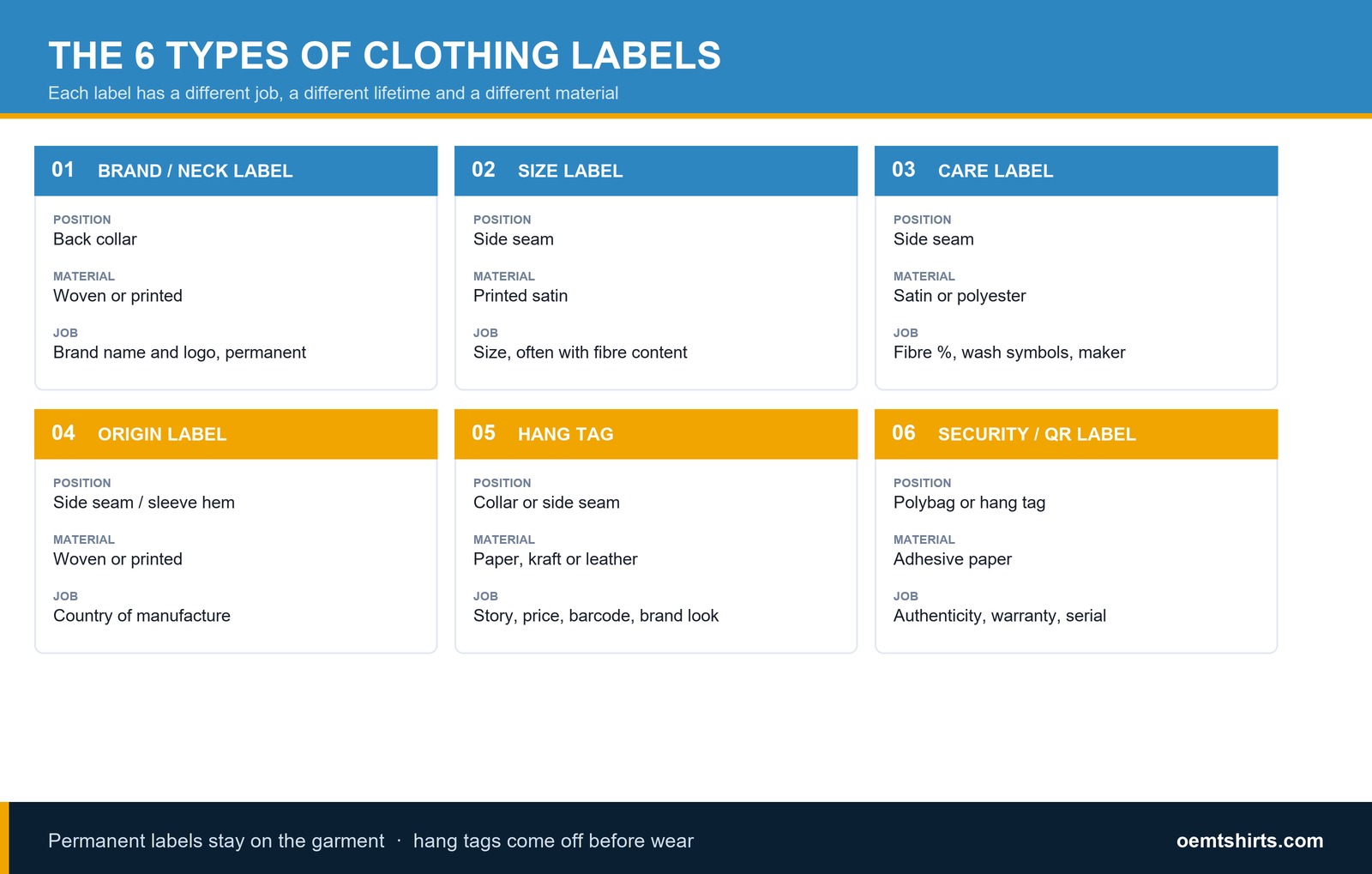
Six label types cover almost every private label apparel order. Not every style needs all six, but every style needs at least a brand label, a size label and a care label. Specifying which custom clothing labels go on which style is the first decision that has to be made before the garment order can be quoted, because each label carries its own material, minimum and lead time. Here is what each one does and when it is required.
1. Brand Label (Neck Label)
The neck label is the label sewn into the back collar, usually the first thing a customer sees when they turn the garment over. It carries the brand name, sometimes the logo, sometimes the slogan and the website. It is the most visible permanent label and the one most likely to be inspected closely at a trade show or in a retail fitting room. Of all the custom clothing labels in a typical order, this is the one where a poor finish is noticed first.
Standard neck label sizes for adult t-shirts run from 25 mm wide × 15 mm tall up to 40 mm × 20 mm for a larger logo. A small printed brand name and a large woven logo cannot share the same label without the label getting bulky, so decide early whether the label is a text-only tag or a full logo patch. If you want a visible logo on the body as well, our comparison of printing methods for custom t-shirts covers the trade-off between screen print, DTG and embroidery.
2. Size Label
The size label states the garment size. For a single-size-per-garment order it can be a small printed tab; for a full size range (XS to 3XL) the factory usually produces one label per size, each printed with that size only, or a single label with all sizes and the matching one cut out. The cut-out approach looks tidier in retail but requires the label to be cut accurately, and it makes size swaps in the warehouse more likely.
Size labels also often carry the fabric composition and the country of origin, which is why many brands combine them into a single sewn label at the side seam. If you are unsure how the label should be positioned relative to the side seam, our custom t-shirt size chart guide explains the measurement conventions used across the industry.
3. Care Label
The care label is the legally important one. It tells the wearer how to wash the garment and identifies the fibre content and the manufacturer. It must be printed with durable ink that survives repeated washing, which in practice means it is usually produced as a satin or printed polyester label rather than paper. Paper care labels exist but are only appropriate for garments that will never be washed. No set of custom clothing labels is complete without one, and no set is compliant without the right content on it.
Care labels also carry your legal identity as the brand, which matters for warranty, returns and traceability. A generic care label with no brand name on it undermines the whole point of a private label order. Our t-shirt manufacturing process explained guide shows where labelling sits in the production sequence, so you can plan it alongside the decoration step.
4. Country of Origin Label
Many import markets require the country of manufacture to be stated on the garment, either on a separate label or on the care label. For US import, the country of origin must be marked on the garment itself; the outer carton alone is not sufficient. Sellers frequently ask us to add a small woven or printed origin label at the left side seam as a separate item.
Origin labels can also be an opportunity rather than an obligation. A small “Made in China” woven label is generic. A finished, branded origin label at the side seam reads as a deliberate design choice, and many brands use it as a subtle quality signal at a price point where the main label is deliberately understated. This is one of the custom clothing labels where the cheapest option and the most professional option are the same thing.
5. Hang Tag (Swing Tag)
The hang tag is the removable card or folded piece of stock that hangs off the garment at the collar. This is where you sell the product: the tag can carry the logo in full colour, the brand story, the material description, the barcode and the size. It is also the piece most likely to be removed by the customer before wearing, so anything legally required should not live only on the hang tag.
For wholesale orders going to a retailer, the hang tag is also where the buyer scans the SKU. Our article on how to order custom logo apparel covers how brands usually split branding between a permanent printed neck label and a full-colour hang tag, because that combination gives the strongest brand moment at the lowest cost.
6. Security, Serial and QR Labels
Higher-value runs often add a security label: a small hologram or QR label that lets the buyer or the brand verify authenticity and, in some cases, unlock a digital product or warranty. On apparel this is usually a small adhesive label on the polybag or on the hang tag rather than a sewn label.
These are simple items to order but they add a supplier in the chain, which means they need a lead time of their own. If your run includes a security or QR label, raise it at the order stage, not at the packing stage.
Label Materials: Which One Should You Choose?
Material determines cost, durability and the way your logo looks. Four families cover almost all apparel labelling work, and the choice is usually driven by the size of the logo and how much washing the garment has to survive. The same three questions come up every time: how big is the artwork, how many colours does it use, and does it have to survive a wash cycle.
Woven Custom Clothing Labels
Woven labels are made from coloured threads, so the logo is stitched rather than printed. This is the most durable option and the only one where the artwork is genuinely colour-accurate rather than a reproduction of the colour. Woven labels hold their shape, do not crack or peel, and survive industrial laundering. They are the standard choice for a brand neck label on a quality t-shirt, and among custom clothing labels they are the only family where the logo itself is the thread rather than a reproduction of it.
The trade-off is the minimum order and the tooling. Detailed logos with fine lines and gradients do not weave well, so the artwork usually needs simplifying and a higher stitch density, which raises the cost. Woven labels are typically quoted at around 1,000 pieces as a starting quantity for a new design, and often cheaper per piece from 3,000 pieces up.
Printed Custom Clothing Labels
Printed labels use ink or digital printing on satin, polyester twill, TYVEK or paper. They are the cheapest way to get a full-colour logo at low volume, and they handle fine detail and gradients that woven construction cannot. Satin printed labels are the most common care label format in the industry, usually around 20 mm × 15 mm to 30 mm × 20 mm.
Paper and TYVEK printed labels are for temporary or non-washable purposes. TYVEK is waterproof and tear-resistant, so it is used for outdoor and sportswear labelling, but it should not go into a washing machine. Printed labels in volume can start around 500 pieces per design, and the unit price drops sharply past 1,000 pieces.
Embroidered Patch Labels
An embroidered patch is a shaped piece of fabric with a stitched border and stitched artwork, usually a leather or felt base with a merrowed edge. Visually it is the premium option: it reads as a fashion label rather than a production label, and it gives a garment a heritage or workwear feel that a flat woven label cannot.
Because the patch is a physical shape, it needs a border and therefore cannot be a free-floating rectangle. An all-over embroidery patch with a full-bleed logo is not possible, the logo needs a margin from the edge. If you want that look, an alternative is a printed leather patch with the logo applied on top.
Leather, Metal and Recycled Options
Leather and faux-leather labels are usually embossed or debossed rather than printed, which gives a subtle, tonal logo that does not crack or fade. Metal labels and foil tags are used on outerwear and caps where the label has to survive hard use. Recycled and organic cotton woven labels are increasingly requested by European and North American buyers who need to evidence their sustainability claims, and they can be woven on natural or recycled thread with recycled backing.
If your sustainability claim is part of the brand, make sure the label material supports it. A recycled-polyester woven label on a garment marketed as organic cotton creates a question a buyer will ask. If you are new to private label sourcing, our private label vs OEM vs ODM comparison explains where a label supplier sits in that model.
Custom Clothing Label Sizes and Placement Specifications
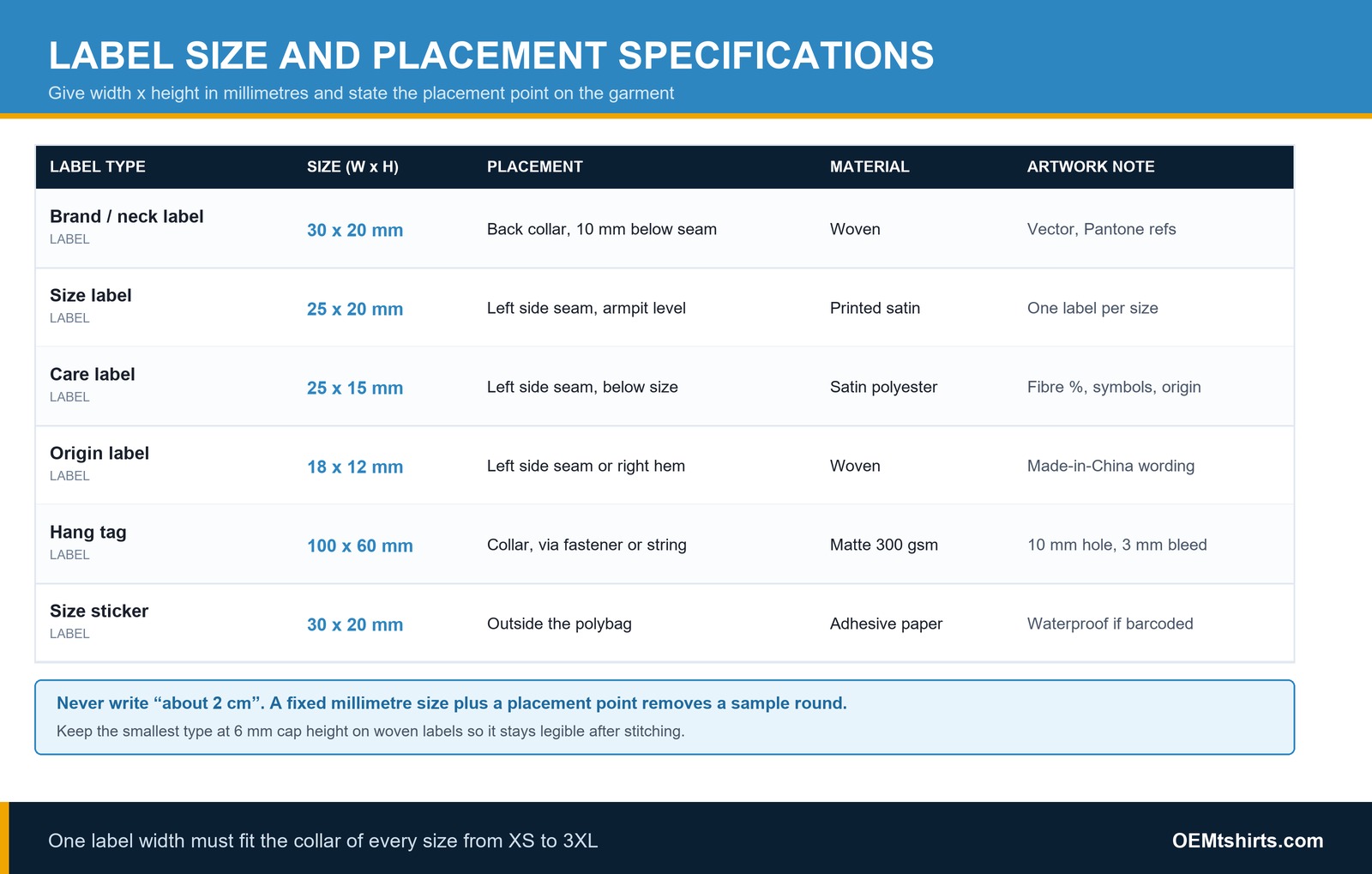
The number that causes the most production friction is the label size, because it is written as a vague dimension in most purchase orders. “Small label, about 2 cm” produces a different result in every factory. Specify both dimensions in millimetres and state the placement point. Every custom clothing label in the pack should carry a millimetre dimension, not a description.
| Label | Typical size (W × H) | Placement | Notes |
|---|---|---|---|
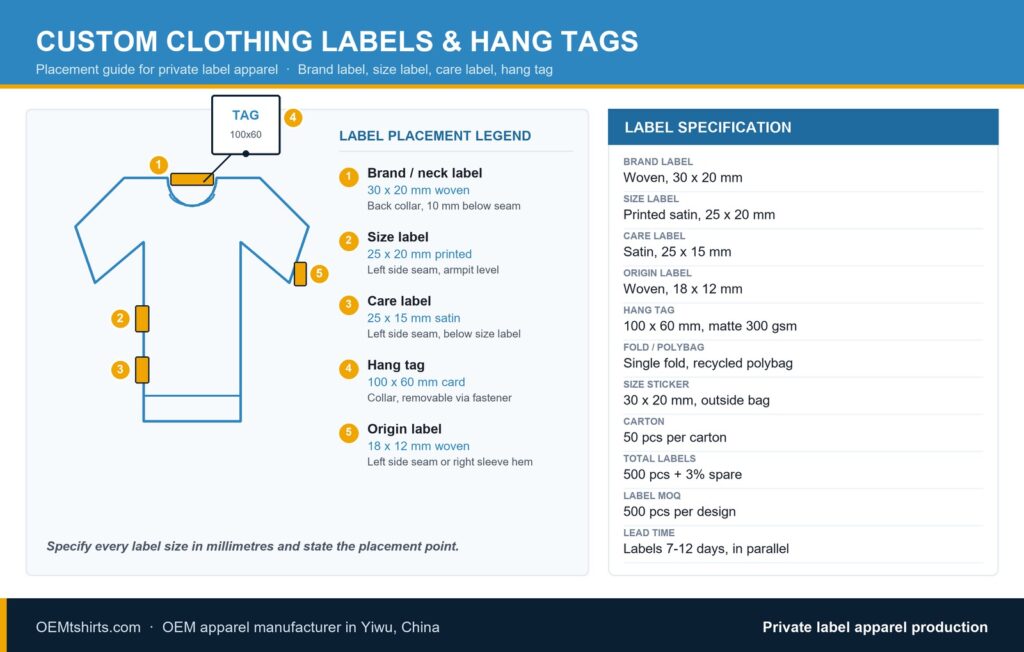
| Neck / brand label | 25 × 15 mm to 40 × 20 mm | Back collar, 8–10 mm below seam | Centre or left back neck |
| Size label | 20 × 15 mm to 25 × 20 mm | Left side seam, armpit level | One label per size |
| Care label | 20 × 15 mm to 30 × 20 mm | Left side seam, below size label | Satin or printed polyester |
| Origin label | 15 × 10 mm to 20 × 12 mm | Left side seam or right sleeve hem | Often combined with care label |
| Hang tag | 90 × 50 mm to 130 × 80 mm | Collar or side seam via fastener | Add 3–5 mm bleed on all sides |
| Size sticker | 30 × 20 mm | Outside of polybag | Waterproof if it carries a barcode |
Two conventions are worth knowing. First, hang tag dimensions are usually given as width × height with the hole position measured from the top edge, typically 8 mm to 15 mm from the top, centred horizontally. Second, the tag itself is usually specified a few millimetres larger than the printed artwork so the design does not run into the fold or the hole. If you are producing folded hang tags, the fold line has to be inside the safe area and away from the logo.
Label placement also affects how the garment is graded. A neck label is cut into the collar seam allowance, so it has to fit the collar of every size from XS to 3XL. On a size range with a narrow neck in the small sizes and a wide neck in the large sizes, one label width cannot fit both without either being cut short or leaving a gap, so the factory will often use the same label width across all sizes. This is why specifying a fixed label size up front saves a sampling round.
Care Label and Content Compliance
Care label content is regulated differently in every market, and it is the one part of labelling where a mistake creates a legal problem rather than an aesthetic one. The general principles are consistent, the details are not. Getting the content of your custom clothing labels right is what separates a compliant shipment from a shipment held at customs.
Fibre Composition
The composition must be stated by weight percentage of each fibre, in descending order, using the standard generic fibre names. “100% cotton” is acceptable; “cotton rich” or “cotton blend” is not, because a blend must be broken down into exact percentages such as 60% cotton, 40% polyester. Custom fibre names such as “organic combed cotton” can be used alongside the percentage, but the percentage remains mandatory.
This is where label content ties back to your fabric choice. If you order a 60/40 cotton-poly blend, the label must say exactly that. Our guide to the best fabrics for private label t-shirts covers the common blends and what each one does, and the composition must match whatever you specify there. Our article on what GSM means in t-shirts explains the weight side of the specification, which usually appears on the hang tag rather than the care label.
Care Symbols and Care Wording
Care instructions can be conveyed as washing symbols or as written instructions, and most markets accept both, although symbol-only labelling is common in Europe and written instructions are more common in North America. Symbols are cleaner on a small label; written instructions are unambiguous for a consumer who does not recognise the symbol set.
A practical detail: symbols must be printed with ink that survives washing, and symbol sets differ slightly between Europe and North America. If your run goes to both regions, confirm which symbol set you are using rather than letting the factory pick. It is also common to add a short written line such as “Wash with like colours” alongside the symbols.
Country of Origin and Manufacturer Identity
The country of manufacture must be marked on the garment for US import, and for EU retail it must be stated on the product or its packaging. The identity of the manufacturer or the responsible party must also appear, which for a private label order means the brand name, not the factory name. Many brands print the brand name in the size label area precisely to satisfy this without adding a separate label.
| Market | Fibre content | Care instructions | Origin | Responsible party |
|---|---|---|---|---|
| EU / UK | Required, % by weight | Required, symbols | Required | Required |
| United States | Required | Required on the garment | Required | |
| Canada | Required | Language requirements apply | ||
| Australia / NZ | Required | Supplier ID may be required | ||
| Japan | Required | Japanese language for care info |
Rules change and differ between state and national authorities, so if your business depends on one specific market, confirm the current requirement with your own compliance adviser before the bulk run rather than after. Our role is to print exactly what you specify, accurately, and to make sure the label survives the wash cycle.
How to Prepare Label Artwork for Production
Label artwork is a production file, not a marketing file. The factory needs to convert it into stitch lines, ink layers or a cutting die, and the more you prepare it, the closer the result comes to your intention and the fewer sample rounds you pay for. Preparing custom clothing labels properly is the same discipline as preparing any other production artwork, with one extra constraint: the artwork has to be designed to a fixed physical size.
File Format and Vector Artwork
Supply vector artwork (AI, EPS, PDF or SVG) for any woven or embroidered label. Raster artwork at 300 dpi can be used for printed labels, but a logo that looks fine on screen at 72 dpi will look soft or stair-stepped at 2 cm. If you only have a raster file, ask the factory to vectorise it and approve the result before the run, which is usually cheaper than reprinting 1,000 labels.
For printed labels, keep the artwork in CMYK with the correct background colour specified, and state the substrate so the ink is chosen for the right material. A logo designed for a white shirt does not automatically work on a black shirt, because printed ink needs an underbase to stay visible on a dark ground.
Minimum Font Size and Minimum Stitch
Small text is the most common reason a label comes back wrong. Below roughly 5 mm cap height, stitched letters start to fill in and become unreadable, and very fine print on a 2 cm label can look like a smudge rather than text. Keep the smallest type at 6 mm or above on a woven label, and treat anything smaller as a job for a printed label instead.
Our guide on how to prepare artwork for t-shirt printing covers resolution, bleed and file structure, and the same principles apply to labels with one difference: a label is a fixed physical size, so the artwork must be designed to that size rather than scaled to fit later.
Colour Matching for Woven Labels
Give a Pantone reference for every colour in the design. Thread dyeing is much closer to a Pantone standard than four-colour process printing is, so a woven label with the right Pantone number will match your brand colour better than a printed label, and it is far less expensive than matching a custom thread shade.
Dark garments need more thought than light ones. A white or light-coloured woven label on a black shirt is high contrast and looks sharp, but a navy label on a navy shirt disappears. Either pick a contrasting colour deliberately or add a printed background under the stitching, which is a specification worth deciding with the factory rather than leaving to chance.
MOQ, Pricing and Lead Time for Custom Labels
Label costs are a small part of the garment cost, but they are the part most often mis-budgeted, because the MOQ is set by the label maker rather than by the apparel factory. This is the part where our role as a reliable manufacturer in China matters: we consolidate the label order with the garment order so you are not managing two separate minimums. In practice, custom clothing labels are cheaper to order alongside the garments than separately.
Typical Minimums
Minimum order quantities for labels vary by material and complexity, and they are also negotiable when the label order is placed alongside a garment order with us. The figures below are typical for a single new design with one colour count.
| Label type | Typical MOQ | Indicative unit price | Sample / lead time |
|---|---|---|---|
| Woven brand label | 500–1,000 pcs | USD 0.10–0.35 | Sample 3–5 days, bulk 10–15 days |
| Printed satin care label | 500–1,000 pcs | USD 0.03–0.08 | Sample 2–3 days, bulk 7–10 days |
| Size label (per size) | 500–1,000 pcs | USD 0.03–0.07 | Bulk 7–10 days |
| Embroidered patch | 300–500 pcs | USD 0.35–0.90 | Sample 5–7 days, bulk 12–18 days |
| Leather / PU label | 300–500 pcs | USD 0.20–0.60 | Sample 4–6 days, bulk 10–14 days |
| Printed hang tag | 500–1,000 pcs | USD 0.08–0.25 | Sample 3–5 days, bulk 7–12 days |
| Size sticker (adhesive) | 1,000 pcs | USD 0.01–0.03 | Bulk 7–10 days |
These are indicative production figures, not a quotation. The real number depends on the label size, the number of colours, the number of positions, the artwork complexity and the material. A single-colour 25 × 15 mm woven label at 1,000 pieces sits at the cheap end of the range; a multi-colour full-logo woven label at 500 pieces sits at the expensive end. If you want a firm number, the fastest route is to send us your artwork and the label specification and we will quote the label line alongside the garment line.
Why Label MOQ Matters More Than It Looks
Garment MOQ and label MOQ are different constraints, and a label order that meets its own minimum but does not match your garment quantity is the most common labelling failure. If you order 800 garments and the label minimum is 1,000, you either buy 1,000 labels and carry 200 spares for the next run, or you pay for a shorter label run that the supplier may not want to run at all. This is why you should tell the factory your exact quantity per size before the label order is placed, and why the total for all of your custom clothing labels should be checked against the garment quantity rather than quoted separately.
Our article on what MOQ to expect from a t-shirt manufacturer covers the garment-side minimums, including the 25-piece-per-design starting point we can work with on basic styles, and the size ratio question that determines how the labels have to be split across the run.
Lead Time
Labels typically add 3 to 7 days of production time on top of the garment schedule, and they can run in parallel with sewing rather than after it. The part that cannot be parallelised is the packaging stage, because the hang tags and size stickers have to be physically in the factory when the garments are folded and bagged. The practical rule is to have the label order placed and the samples approved before the bulk sewing run starts.
For the garment side of the schedule, our guide to how long t-shirt manufacturing takes sets out the sample and bulk timings, and the China t-shirt manufacturing guide covers the full end-to-end timeline including inspection and shipping.
Common Label Mistakes That Delay Production
These are the errors we see most often, and every one of them adds a round trip.
- Vague sizes. “About 2 cm wide” produces a different label in every factory. Specify width × height in millimetres.
- Missing position. “Sewn in” does not say where. State the placement point and the distance from the seam.
- No size breakdown. If you order five sizes and do not say how many of each, the factory has to guess the label split and the size ratios together.
- Care label content left blank. If the compliance content is not supplied, it cannot be invented after sampling.
- Wrong fibre percentage. The label says 100% cotton and the fabric is a blend. This is a customs and compliance problem, not a cosmetic one.
- Artwork that cannot be produced in the chosen process. Fine gradients and thin strokes do not weave, and small type disappears at label scale.
- No Pantone reference. “Same blue as the shirt” is not a specification the label maker can act on.
- Labels ordered after production. A label order placed after the bulk run has finished adds weeks and requires a second factory slot.
- Hang tag artwork with no bleed. A background colour that stops at the trim line shows a white edge after cutting.
- Forgetting the size sticker. A folded size range needs a barcode or size sticker on the polybag, and it is easy to leave out.
Custom Clothing Label and Hang Tag Checklist Before You Order
Use this as the specification sheet you send us. Every line answered means one less clarification email and a faster quote. If you send a completed version of this table for your custom clothing labels alongside your garment spec, the whole order can be quoted in one message.
| Item | What to specify | Typical answer |
|---|---|---|
| Label types required | Brand, size, care, origin, hang tag, sticker | Brand + size + care + hang tag |
| Label size (W × H) | Millimetres for every label | Brand 30 × 20 mm, care 25 × 15 mm |
| Placement | Position and distance from seam | Back collar, 10 mm below seam |
| Material | Woven / printed / embroidered / leather | Woven brand label, printed satin care label |
| Artwork file | Vector AI / EPS / PDF, Pantone refs | Vector, 3 Pantone colours |
| Care label content | Fibre %, symbols, origin, brand identity | 100% cotton, 5 wash symbols, Made in China |
| Hang tag details | Size, hole position, fold, paper stock | 100 × 60 mm, 10 mm hole, matte 300 gsm |
| Quantity per size | Size ratio for the whole run | S 60 / M 180 / L 150 / XL 80 / 2XL 30 |
| Total label quantity | Total plus matching spare percentage | 500 pcs + 3% |
| Attachment method | String, fastener or fold-over tab | Fold-over tab, white string |
When this table is complete, the label line can be quoted with the garment line in the same message, which means your labels and your garments arrive together instead of in two shipments at two prices.
Frequently Asked Questions
Do I need hang tags if my garments already have printed neck labels?
Not strictly, but most brands use both because they serve different purposes. The sewn neck label is the permanent brand marker that survives washing, and the hang tag is where you can carry full-colour artwork, the product story and a barcode. For a first run of 100 to 300 pieces aimed at samples, wholesale samples and small batches, many brands skip the hang tag to save both cost and the packing time it adds. For a retail launch it is worth including. If you are weighing up the two, remember that hang tags sit alongside your custom clothing labels rather than replacing them.
Can I reuse one label design across all my styles?
Usually yes. A single brand label often works across a whole range as long as the neck size and the garment type are compatible, since the label is cut to the collar seam allowance. Where it breaks down is when one style has a much narrower or wider neck than the others, or when the brand label has to carry style-specific information such as the fabric composition. For a range where the fabric differs between styles, the care label content changes even though the brand label does not.
Who supplies the labels, me or the factory?
Either works. You can send us artwork and we produce the labels with your garments, which is usually the simplest route because we consolidate the minimums and the shipping. Alternatively you can nominate your own label supplier and have the factory sew them in, which gives you more control over the label design but adds a third party to the schedule and means you are responsible for delivering the labels to the factory before sewing starts. If you are working with us for the first time, sending everything through one order is the lower-risk route.
Can labels be tested before the bulk run?
Yes, and you should. A label sample is a cheap, fast check that takes a few days and can be done alongside the garment sample. It verifies the artwork, the colour, the size and the placement all at once, which is considerably more efficient than finding out at final inspection that the neck label is 3 mm too wide for the collar.
How do labels affect the unit price?
Labels are usually a fraction of a cent to a few tens of cents per garment, depending on the material and the quantity. On a basic mid-price t-shirt, the label line often represents 2% to 5% of the landed unit cost. Embroidery patches and leather tags sit at the top of that range, printed care labels at the bottom. Our guide to how much it costs to manufacture t-shirts breaks the unit cost down so you can see where each component sits.
Start Your Next Run With the Label Spec Locked
Labels are cheap, fast and completely within your control, and they are the point where a private label order either looks designed or looks assembled. Send us your artwork, your label specification and your size breakdown, and we will quote the labels and the garments together and deliver them in the same shipment. Custom clothing labels are the fastest upgrade on a garment you already know how to make.
Whether you are starting from a single basic style or building a full range, our guide to choosing a t-shirt manufacturer covers the questions to ask any supplier before you commit, and our wholesale apparel catalogue shows the base garments we can build your labels onto. For pricing on a specific run, send the details and we will come back with a line-by-line quotation.
