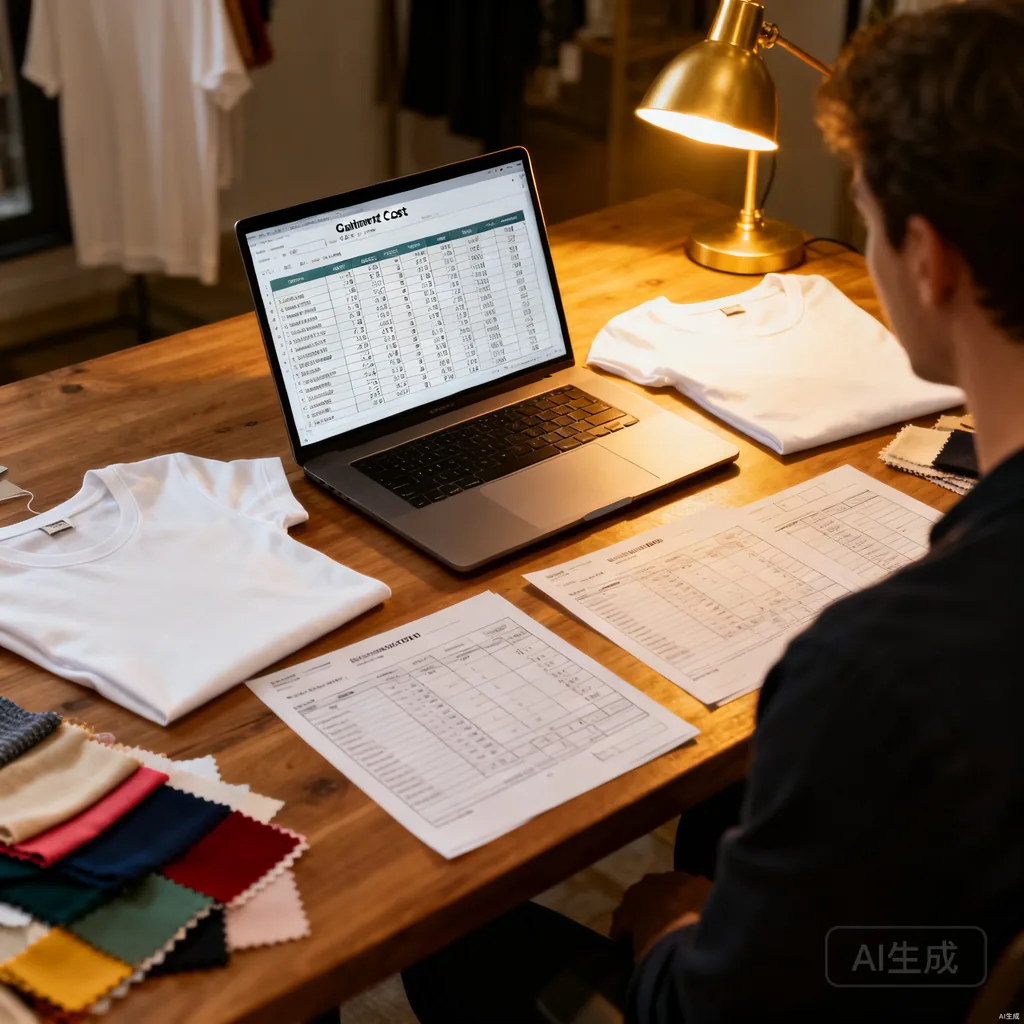
One of the most common questions from new brands is: how much does it cost to manufacture t-shirts? The answer depends on fabric, printing, quantity, and shipping. This guide breaks down every cost component so you can budget accurately.
Cost Breakdown Per T-Shirt
- Fabric: $0.80-2.50 per shirt depending on GSM and fiber type. 150 GSM cotton is cheapest; organic cotton and specialty fabrics cost more.
- Cutting and Sewing: $0.30-0.80 per shirt. Complex patterns and oversized cuts cost more.
- Printing: $0.20-2.00 per shirt. 1-color screen print is cheapest; DTG and multi-color prints cost more.
- Labels and Tags: $0.05-0.20 per shirt for custom neck labels and hang tags.
- Packaging: $0.05-0.30 per shirt for poly bags, tissue paper, or custom boxes.
- Shipping: $0.30-1.50 per shirt depending on method (sea vs air) and destination.
Total Cost Ranges
- Budget (150 GSM, 1-color print, 500+ qty): $2.00-3.50 per shirt landed
- Mid-range (180 GSM, 2-color print, 200+ qty): $3.50-5.50 per shirt landed
- Premium (240 GSM, embroidery, 100+ qty): $5.00-8.00 per shirt landed
How Quantity Affects Price
Quantity is the single biggest cost factor. At 25 pieces, you might pay $6 per shirt. At 500 pieces, the same shirt drops to $3. At 5,000 pieces, it could be $2. This is because setup costs (screens, patterns, fabric sourcing) are spread across more units.
Fabric Cost by Type
- 100% Cotton (carded): $0.80-1.20 per shirt
- 100% Cotton (combed): $1.00-1.60 per shirt
- CVC blend: $0.90-1.40 per shirt
- Tri-blend: $1.20-1.80 per shirt
- Organic cotton: $1.50-2.50 per shirt
- Lyocell/Bamboo: $1.80-3.00 per shirt
Printing Cost Comparison
- Screen printing (1 color): $0.20-0.50 per shirt
- Screen printing (4 colors): $0.80-1.50 per shirt
- DTG printing: $0.80-2.00 per shirt
- DTF printing: $0.60-1.50 per shirt
- Embroidery: $1.00-3.00 per shirt
How to Reduce Manufacturing Costs
- Order larger quantities to spread setup costs
- Choose standard fabrics instead of custom-dyed
- Limit print colors (screen printing)
- Use simple garment constructions
- Ship by sea instead of air for large orders
Conclusion
T-shirt manufacturing costs range from $2-8 per piece depending on your specifications. The best way to get accurate pricing is to request a detailed quote with your exact requirements.
Detailed Cost Breakdown
Here is a comprehensive cost breakdown for a typical custom t-shirt program of 500 units, midweight 200 GSM cotton, 2-color screen print on front.
| Cost Component | Per Unit | 500 Units Total | % of Total |
|---|---|---|---|
| Blank t-shirt (200 GSM, mid-grade cotton) | $3.20 | $1,600 | 42% |
| Screen printing setup (2 screens) | $0.40 | $200 | 5% |
| Print labor and ink | $0.80 | $400 | 10% |
| Cut and sew labor | $1.10 | $550 | 14% |
| Quality control and inspection | $0.20 | $100 | 3% |
| Custom labels and hangtags | $0.30 | $150 | 4% |
| Polybag and carton packaging | $0.15 | $75 | 2% |
| Sea freight (China to US West Coast) | $0.80 | $400 | 10% |
| Duties and customs clearance (10% rate) | $0.60 | $300 | 8% |
| Factory margin | $0.10 | $50 | 2% |
| Total landed cost | $7.65 | $3,825 | 100% |
Hidden Costs Most Brands Miss
Beyond the obvious production costs, several hidden costs can blow your budget if you do not plan for them. These include: sampling fees (typically $50-200 per sample iteration), artwork setup fees for embroidery or screen printing, color matching fees for non-stock Pantone colors, custom label setup fees, packaging customization, fumigation certificates for wood packaging, customs broker fees, warehousing fees if you cannot receive the shipment immediately, and inspection fees if you hire a third-party QC company.
Always add a 10-15% contingency buffer to your initial budget to absorb these surprises without stress.
Cost Reduction Strategies
Five proven ways to reduce your per-unit cost without sacrificing quality: (1) order in larger quantities to unlock volume discounts, (2) standardize on a single fabric and color to reduce complexity, (3) simplify your design to fewer print colors, (4) choose efficient packaging like flat-pack instead of individual polybags, and (5) consolidate shipping with other brands using a freight forwarder.
Frequently Asked Questions
What is the minimum budget to start a t-shirt brand?
A reasonable starting budget is $5,000-$10,000 for 200-500 units, including samples, production, shipping, and initial marketing. Below $3,000, you will be limited to 50-100 units and have less negotiating power with factories.
How much should I charge for my t-shirts?
A common rule of thumb is to price your t-shirts at 3-4x your landed cost. If your landed cost is $7.65, retail at $25-30, wholesale at $15-18. Premium brands can mark up 5-8x if the brand positioning supports it.
Is it cheaper to print locally or in China?
For quantities under 100 units, printing locally (US, Europe) is often cheaper when you factor in shipping and import duties. For quantities above 500 units, China is significantly cheaper. The break-even point depends on your design complexity, but typically falls around 200-300 units.
What payment methods do Chinese factories accept?
Most accept T/T (wire transfer), with 30% deposit and 70% balance before shipping. Some accept PayPal for smaller orders (with a 3-5% fee). Trade Assurance through Alibaba is a safe option for first-time orders. Letter of Credit is the safest for orders above $50,000.
Hidden Costs Most Beginners Miss
The biggest financial surprises for first-time custom apparel brands come from costs that are easy to overlook in the initial budget. Custom labels and tags run $0.20-0.50 per unit, but they are essential for building a real brand. Packaging (polybags, stickers, inserts, branded mailers) adds $0.50-2.00 per unit depending on the level of presentation. Warehousing and fulfillment cost $1-5 per order if you use a third-party logistics provider. Photography for your product listings costs $200-1,000 for a professional shoot. Marketing and advertising typically run 15-30% of revenue in the first year. Returns and exchanges average 5-15% of orders and eat into your margin if not budgeted.
A complete first-year budget should include all of these line items plus a 10-15% contingency for unexpected costs. Brands that plan for these from day one are far more likely to survive the critical first 18 months.
ROI and Margin Calculator
Here is a realistic margin breakdown for a custom apparel brand. Assume a landed cost of $6 per unit (including production, shipping, and duties) and a retail price of $32. Gross margin per unit is $26, or 81%. After payment processing (3% = $0.96), platform fees (10% on marketplaces like Amazon = $3.20), marketing (20% of revenue = $6.40), and overhead ($2 per unit allocated), your net margin is approximately $13.44 per unit, or 42%. This is healthy for a direct-to-consumer apparel brand and supports reinvestment in growth.
The math changes dramatically with volume. At 5,000 units per year, your landed cost drops to $4.50 per unit and your marketing cost drops to 12% of revenue (better data, more efficient ads). Your net margin rises to approximately $18 per unit, or 56%. This is why scaling production and mastering customer acquisition are the two biggest levers for profitability in custom apparel.
Negotiating Better Pricing With Your Manufacturer
Most manufacturers have built-in margin that can be negotiated down, especially as your order volume grows. Here are the most effective negotiation tactics. First, get competing quotes from at least three qualified factories. Use these as leverage, but never lie about competing prices; manufacturers talk to each other and lying destroys trust. Second, offer to consolidate orders or commit to a longer-term relationship in exchange for better pricing. Factories value predictable revenue and will often discount for it. Third, ask for a tiered pricing structure where your price drops at 500, 1,000, and 2,500 units, giving you a built-in path to better margins as you scale. Fourth, propose paying a slightly higher deposit (50% instead of 30%) in exchange for a lower per-unit price. This reduces the factory’s risk and gives you a tangible discount.
Always negotiate respectfully and in writing. A good manufacturer relationship is worth far more than a 5% discount achieved through aggressive tactics. Build trust, communicate clearly, and pay on time. These three habits will get you better pricing and better service over the long term than any single negotiation tactic.
Scaling Your Brand Beyond the First Order
Your first order is the hardest. Once you have a successful product, the path to scaling is clear but requires discipline. Reorder your proven best-sellers every 4-8 weeks to maintain consistent inventory. Expand your color palette based on customer requests and sales data. Add complementary products (long-sleeve tees, hoodies, hats) that share the same fabric and decoration techniques. Test new markets (wholesale to boutiques, custom orders for corporate clients, collaborations with influencers). Invest in brand storytelling and customer experience to build loyalty and repeat purchases.
At OEM T-Shirts, we partner with brands throughout this growth journey, from the first 50-piece sample order to 10,000-piece production runs. Our team helps you optimize cost, quality, and lead time at every stage. Whether you are just starting or scaling to seven figures in revenue, we have the capacity and expertise to support your growth.
Working With OEM T-Shirts on Your Project
At OEM T-Shirts, we have helped hundreds of brands bring their custom apparel ideas to life on time and on budget. Whether you are launching a single product or building a full collection, our team provides transparent pricing, fast sampling, reliable quality, and end-to-end logistics support. We are not the cheapest factory, but we are one of the most reliable. Our clients stay with us year after year because we deliver what we promise, every time.
To get started, send us your design, your target quantity, and your preferred fabric weight. We will respond within 24 hours with a detailed quote, sample timeline, and production plan. From there, you will receive samples in 7-10 days, and bulk production will begin immediately after your approval. Most first-time clients receive their first bulk order in 8-10 weeks, with reorders typically delivered in 6-8 weeks.
