
In OEM apparel manufacturing, quality is not something you inspect into the product at the end. It is something you build into the process from the start. But even the best production lines produce defects, which is why a robust quality control system is non-negotiable for any brand that wants to maintain its reputation. This guide walks you through the complete QC process used by professional OEM garment factories.
The Four Stages of Garment QC
Professional garment QC happens at four distinct stages. Catching a defect early saves exponentially more money than catching it late, because the cost of a defect multiplies at each stage as value is added to the product.
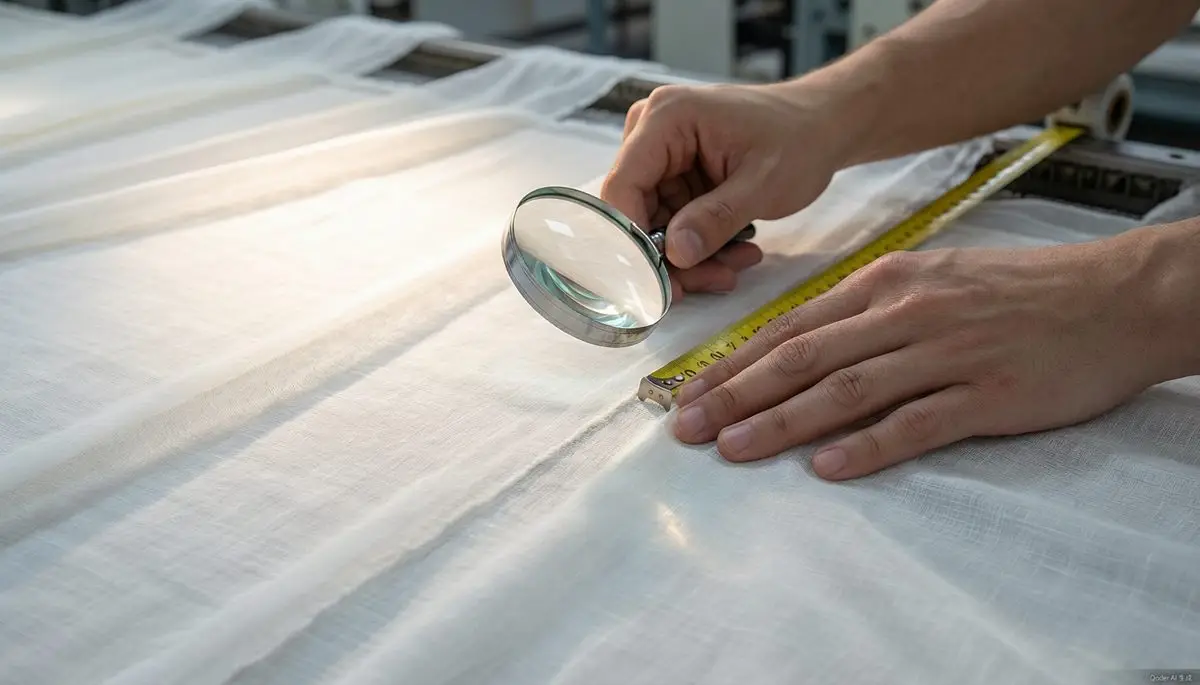
Stage 1: Raw Material Inspection
Before production begins, every roll of fabric and every batch of accessories must be inspected:
- Fabric weight (GSM): Cut a 10x10cm sample and weigh it on a precision scale. Compare to the specified GSM with a tolerance of +/- 5%. Fabric that is too light indicates cost-cutting; too heavy means you are overpaying.
- Color consistency: Compare fabric against the approved lab dip under standard D65 lighting. Check for shade variation between rolls using a gray scale (rating 4-5 is acceptable, below 4 is rejected).
- Fabric defects: Inspect using the 4-point system (ASTM D5430). Roll fabric on an inspection machine with backlighting. Mark defects (holes, slubs, oil stains, weaving errors) and calculate a defect score. Rolls exceeding the acceptable limit are rejected or downgraded.
- Shrinkage test: Cut a 50x50cm fabric sample, mark reference points, wash and dry per the care label, then measure. Shrinkage should be within +/- 3% for woven and +/- 5% for knitted fabrics.
- Accessories check: Verify zippers, buttons, snaps, labels, and thread match the approved quality and color. Test zipper smoothness, button attachment strength, and label accuracy.
Stage 2: In-Process Inspection (During Production)
Also called DUPRO (During Production Inspection), this happens when 10-20% of the order is completed. The inspector checks:
- Cut panel accuracy against the pattern template
- Print or embroidery quality on semi-finished pieces
- Sewing quality: stitch density (SPI), seam allowance, back-tack reinforcement
- Assembly sequence and construction methods match the approved sample
- Measurement of 5-10 random pieces from the production line against the size spec sheet
- Any corrective actions needed are flagged immediately before the full order is completed
DUPRO is critical because it is the last chance to catch systematic errors before the entire order is sewn. A stitching mistake found at DUPRO affects 10% of the order. The same mistake found at final inspection affects 100%.
Stage 3: Pre-Shipment Inspection (PSI)
This is the formal inspection when 100% of the order is packed and ready to ship. Most brands use the ANSI/ASQ Z1.4 sampling standard (equivalent to ISO 2859-1) for statistical sampling:
- Sample size: Based on order quantity. For 500 pieces, inspect 80 pieces (Accept 5, Reject 6 under General Inspection Level II).
- Measurement check: Measure all critical points (chest, length, shoulder, sleeve) on each sample piece. Tolerance is typically +/- 0.5 to 1 inch depending on the measurement point.
- Workmanship check: Examine each piece inside and out for sewing defects, stains, loose threads, print defects, and labeling errors.
- Function test: Test zippers, snaps, buttons, drawstrings, and any functional features.
- Packing check: Verify poly bag quality, size labels, carton markings, packing ratio, and carton strength.
Stage 4: Lab Testing (Third-Party)
For brands selling in regulated markets, third-party lab testing is not optional. Common tests include:
- Colorfastness: Wash, light, rubbing (crocking), and perspiration colorfastness per AATCC or ISO standards.
- Dimensional stability: Shrinkage after washing per ASTM D6939 or ISO 6330.
- Chemical compliance: CPSIA (US children’s products), REACH (EU), Prop 65 (California) for lead, phthalates, formaldehyde, and restricted azo dyes.
- Flammability: Required for children’s sleepwear in the US (16 CFR 1615/1616).
- Button/snaps pull test: Critical for children’s wear. Small parts must withstand 90N pull force to prevent choking hazards.
Common Garment Defects and How to Classify Them
Not all defects are equal. Professional QC classifies defects into three categories:
- Critical defects: Unsafe or hazardous conditions (broken needle in garment, sharp edges on accessories, chemical contamination, choking hazard from detachable small parts on children’s wear). Zero tolerance. The entire shipment must be held.
- Major defects: Likely to result in customer return or complaint (wrong size label, visible stains, open seams, incorrect color, print misalignment over 3mm, wrong packaging). Typically 2.5% AQL (Acceptable Quality Limit).
- Minor defects:Does not significantly affect function or appearance but is outside spec (minor loose threads under 1cm, slight shade variation within tolerance, internal labeling slightly off-position). Typically 4.0% AQL.
Building a QC Relationship With Your OEM Supplier
The best QC strategy is one where the factory’s internal QC and your QC work as partners, not adversaries. Here is how to build that relationship:
- Provide a detailed tech pack: Every measurement, tolerance, fabric spec, color reference, and construction detail should be documented. Ambiguity is the enemy of quality.
- Approve a gold seal sample: Before bulk production, approve a perfect sample signed and dated by both parties. This becomes the reference standard for all inspections.
- Define AQL standards in your purchase order: Agree on inspection levels and AQL limits before production starts, not after defects are found.
- Hire a third-party inspector for initial orders: Until you trust the factory’s internal QC, invest in independent inspection. SGS, Bureau Veritas, and Intertek all offer garment inspection services.
- Visit the factory: Nothing replaces seeing the production floor. Check their fabric storage conditions, machine maintenance, QC stations, and worker skill levels.
The Cost of Skipping QC
Some brands, especially those new to OEM production, view QC as an unnecessary expense. Consider the real costs of skipping it: a 500-piece order with a systematic sizing error costs thousands in rework or replacement. A shipment held at customs for chemical non-compliance can destroy your brand’s import privileges. A batch of T-shirts that shrinks 10% after the first wash generates returns, negative reviews, and lost customers. The cost of proper QC is typically 2-5% of the order value. The cost of skipping it can be 100% of the order value plus your reputation.
Quality control is not just about catching problems. It is about building a system where problems are prevented. The brands that thrive in custom apparel are the ones that treat quality as a competitive advantage, not a cost center.
QC Documentation: What Records to Keep
Proper documentation protects your brand when disputes arise. Every quality issue is easier to resolve when you have clear records. Here is the documentation framework professional brands maintain:
- Tech pack version history: Every revision to your tech pack should be dated, signed, and archived. When a defect is traced to an ambiguous specification, version history determines responsibility.
- Approval records: Lab dips, strike-offs, hand feel samples, and gold seal samples should all be physically archived with date stamps and signatures. Digital photos alone are not sufficient for dispute resolution.
- Inspection reports: Every DUPRO and PSI inspection should generate a formal report with photos, measurement data, defect classification, and the inspector’s conclusion (pass/fail). These reports should be shared with the factory within 24 hours of inspection.
- Lab test certificates: Keep original test certificates from accredited laboratories for every production batch. These are required for customs clearance in many markets and for retailer compliance audits.
- Corrective action records: When defects are found, document the root cause, corrective action taken, and preventive measures implemented. This creates a feedback loop that improves quality over successive orders.
Technology in Modern Garment QC
The garment industry is rapidly adopting technology to improve inspection accuracy and efficiency. Understanding these tools helps you evaluate your OEM supplier’s capabilities:
- Automated fabric inspection machines: Modern machines use cameras and AI to detect fabric defects at speeds up to 30 meters per minute, far exceeding human visual inspection. They classify defects by type and severity, generating digital reports. Factories with this equipment produce fewer fabric-related defects.
- Digital measurement systems: Instead of manual tape measurements, some factories use projected templates or laser measurement systems that reduce human error and speed up the measurement process. This is particularly valuable for high-volume orders.
- Color spectrophotometers: These devices measure color numerically rather than relying on subjective visual assessment. They quantify color differences using Delta E values, where Delta E below 1.0 is generally considered an acceptable match. Factories with spectrophotometers have fewer color-related disputes.
- Cloud-based QC platforms: Services like QIMA, AsiaInspection, and SGS Connect allow brands to manage inspections, view real-time reports, and track quality trends across multiple suppliers from a single dashboard. This is especially useful for brands working with multiple factories.
Market-Specific Compliance Requirements
Different markets have different regulatory requirements for apparel. Failing to meet them can result in customs holds, fines, or product recalls. Here are the key requirements by market:
- United States: CPSIA compliance is mandatory for children’s products (under 13), requiring third-party testing for lead, phthalates, and flammability. Adult apparel requires care labeling per FTC rules (16 CFR 423) and proper country-of-origin marking. California Prop 65 requires warning labels for products containing chemicals known to cause cancer or reproductive harm.
- European Union: REACH regulation restricts over 200 chemicals in textiles, including certain azo dyes, nickel in accessories, and specific phthalates. The EU is also implementing the ESPR (Ecodesign for Sustainable Products Regulation), which will require digital product passports for textiles by 2027.
- United Kingdom: Post-Brexit UKCA marking replaces CE marking for certain product categories. Textile labeling must comply with UK Textile Products (Labelling and Fibre Composition) Regulations 2012.
- Australia: Mandatory safety standards for children’s clothing (AS/NZS 1908) require specific labeling and restrictions on drawstrings and cords that pose strangulation risks.
Always confirm your target market’s compliance requirements before placing a bulk order. A professional OEM supplier will have experience with these regulations and can guide you through the testing and certification process. Request their previous test certificates for similar products as evidence of their compliance track record.
Looking for an OEM partner with rigorous quality standards? Request a quote and learn about our multi-stage QC process and quality guarantees.
Start Your Quality Order
Every order from our factory passes rigorous inspection:
- Cotton T-Shirts — GSM tested, shrinkage-controlled fabrics
- About Our QC Process — 3-stage inspection protocol
- Request a Quote — Get pricing within 24 hours
