Choosing between screen printing and DTF (Direct-to-Film) is one of the most common dilemmas when ordering custom t-shirts. Both techniques produce vibrant, durable prints, but they work very differently and excel in different situations. This guide breaks down everything you need to know to make the right choice for your project.
What Is Screen Printing?
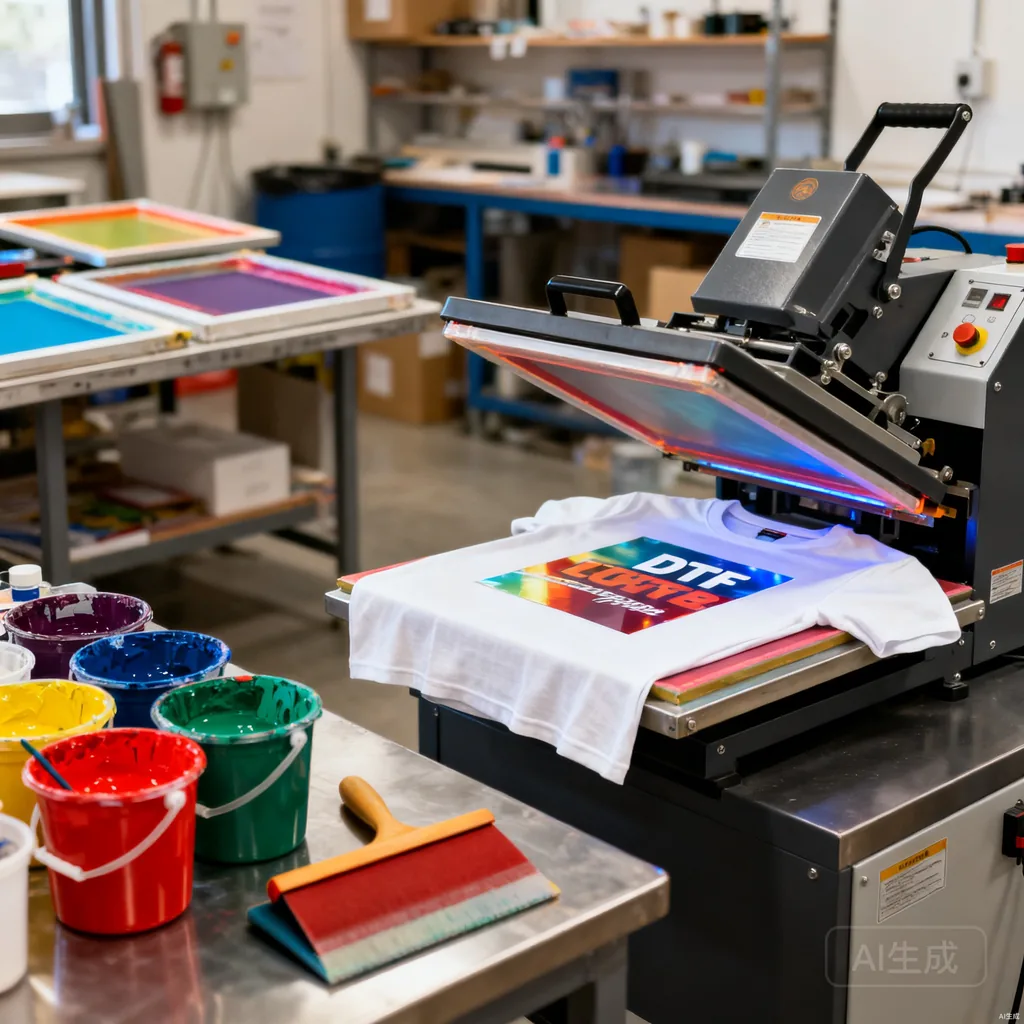
Screen printing (also called silk screen printing) is the oldest and most widely used technique for printing on garments. It works by creating a stencil (called a “screen”) for each color in your design, then pushing ink through the screen onto the fabric using a squeegee.
Each color in your design requires a separate screen. A simple 1-color logo needs just one screen. A full-color photograph might need 4-6 screens (CMYK + spot colors). This setup process makes screen printing most cost-effective for larger quantities.
What Is DTF Printing?
DTF (Direct-to-Film) is a newer digital printing technology. The design is printed onto a special PET film using water-based inks, then coated with a hot-melt adhesive powder. The film is then heat-pressed onto the garment, transferring the design.
Unlike DTG (Direct-to-Garment), which prints directly onto the fabric, DTF prints onto a film first and then transfers. This gives it unique advantages: it works on virtually any fabric color and type, including dark fabrics, without pretreatment.
Screen Printing vs DTF: Head-to-Head Comparison
Print Quality
Screen printing produces bold, opaque colors with a slightly raised texture you can feel. It excels at solid colors and simple graphics. Fine details and gradients are possible but require skilled setup.
DTF produces photo-quality prints with smooth gradients and fine details. Colors are vibrant but sit on top of the fabric as a thin film layer. On dark fabrics, DTF maintains color accuracy better than screen printing without needing a white underbase.
Durability
Screen printing is the gold standard for durability. Plastisol inks bond deeply with fabric fibers and can withstand 100+ washes without significant fading. Water-based inks soften over time for a vintage feel.
DTF prints are durable but generally last 50-80 washes before showing wear. The adhesive layer can crack on heavily stretched fabric over time. Quality varies significantly between DTF film and ink manufacturers.
Cost
Screen printing has high setup costs (creating screens) but very low per-unit costs. At 100+ pieces, it is significantly cheaper per shirt than DTF. At 10-25 pieces, the setup costs make it expensive per unit.
DTF has virtually no setup cost, making it ideal for small batches and one-off prints. However, the per-unit cost stays relatively constant regardless of quantity. For large orders (500+), DTF becomes more expensive than screen printing.
Color Limitations
Screen printing is limited by the number of screens. Each additional color adds cost and setup time. Gradients and photographic images require simulated process printing (4-6 colors) which is complex and expensive for small runs.
DTF has no color limitations. It prints full CMYK + white automatically. Photographic images, gradients, and unlimited colors all cost the same. This is DTF’s biggest advantage.
Fabric Compatibility
Screen printing works best on cotton and cotton-blend fabrics. Printing on polyester requires special inks and techniques. Some fabrics (nylon, waterproof materials) are difficult to screen print.
DTF works on almost any fabric: cotton, polyester, blends, nylon, canvas, denim, even leather. This versatility is a major advantage for brands that produce diverse products.
Feel and Hand
Screen printing with water-based inks has a soft hand (you barely feel the print). Plastisol inks leave a noticeable layer on the fabric — some customers love this texture, others prefer a softer feel.
DTF prints have a thin, smooth film layer on the fabric. It is softer than plastisol but more noticeable than water-based screen printing. On lightweight fabrics, the print area may feel slightly stiff.
When to Choose Screen Printing
- Orders of 100+ pieces with the same design
- Simple designs with 1-4 solid colors
- Maximum durability is required (workwear, uniforms)
- You want the softest possible print feel (water-based inks)
- Your budget per unit needs to be as low as possible at volume
- Special effects: metallic, glow-in-the-dark, high-density, foil
When to Choose DTF
- Small batches (1-100 pieces) or one-off custom prints
- Complex designs with many colors, gradients, or photographs
- Printing on diverse fabric types (polyester, nylon, blends)
- Printing on dark-colored garments without extra setup
- Quick turnaround needed (no screen setup time)
- Testing a new design before committing to screen printing
Can You Combine Both Techniques?
Yes! Many professional brands use a combination: screen printing for the main design (for durability and cost) and DTF for small detail elements or limited edition variations. Some manufacturers also combine screen printing with embroidery for a mixed-media premium look.
Frequently Asked Questions
Which lasts longer: screen printing or DTF?
Screen printing generally lasts longer, especially with plastisol inks. A well-printed screen print can survive 100+ washes, while DTF typically lasts 50-80 washes. However, high-quality DTF with premium films and inks can approach screen printing durability.
Is DTF better than screen printing?
Neither is universally better. Screen printing excels at large runs with simple designs. DTF excels at small runs with complex designs. The right choice depends on your specific project requirements.
Can DTF print on black t-shirts?
Yes, DTF prints white ink automatically as a base layer, so designs on black or dark garments remain vibrant without any extra setup. Screen printing on dark garments requires an additional white underbase screen.
What about DTG vs DTF?
DTG (Direct-to-Garment) prints directly onto the fabric, while DTF prints onto film first then transfers. DTG works best on 100% cotton light garments. DTF works on more fabric types and colors. DTG has a softer hand feel; DTF is more versatile.
Conclusion
The screen printing vs DTF decision comes down to three factors: quantity, design complexity, and budget. For large runs with simple designs, screen printing is unbeatable. For small batches with complex artwork, DTF is the clear winner. Many successful brands use both techniques depending on the project.
Need help deciding which technique is right for your project? Send us your design and we will recommend the best printing method with a detailed quote.
When to Choose Screen Printing
Screen printing remains the best choice in several specific scenarios. Choose screen printing when you are ordering 50 or more units of the same design, when you need exact Pantone color matching, when your design has 4 or fewer spot colors, when you want a soft hand-feel that improves with each wash, or when you need maximum durability on heavyweight cotton garments.
Screen printing also wins for promotional t-shirts, sports team uniforms, and any program where cost per unit at scale is the primary decision factor. The setup cost is higher than DTF, but the per-unit cost drops dramatically as quantity increases.
When to Choose DTF
DTF is the better choice when you need full-color photographic prints, when your order quantity is below 50 units, when your design includes gradients, shadows, or fine details smaller than 1mm, when you need fast turnaround (DTF prints in seconds per garment, screen printing requires setup), or when you are printing on a variety of garment colors and styles in the same run.
DTF is also ideal for small-batch custom apparel, personalized merchandise, sample runs before committing to bulk, and any program where design flexibility matters more than per-unit cost.
Cost Comparison by Quantity
| Quantity | Screen Printing (per unit) | DTF (per unit) | Winner |
|---|---|---|---|
| 10 units | $8.00 – $12.00 | $5.00 – $7.00 | DTF |
| 50 units | $4.50 – $6.50 | $4.50 – $6.50 | Tie |
| 100 units | $3.20 – $4.80 | $4.20 – $6.20 | Screen printing |
| 500 units | $2.40 – $3.40 | $3.80 – $5.50 | Screen printing |
| 1000+ units | $1.90 – $2.80 | $3.50 – $5.20 | Screen printing |
Frequently Asked Questions
Is DTF as durable as screen printing?
Modern DTF prints are highly durable and typically last 50+ wash cycles without significant fading or cracking. Screen printing, especially with plastisol inks, can last 75-100+ wash cycles. For most custom apparel programs, the difference in durability is negligible in real-world use.
Can you do both on the same order?
Yes. Many brands use screen printing for the main chest logo and DTF for sleeve or back details, or screen printing for one color and DTF for the full-color element. This hybrid approach is common and lets you optimize cost and quality per element.
Does DTF feel rough on the shirt?
Older DTF prints could feel slightly plastic-like. Modern DTF with hot-peel film and proper curing produces a soft hand-feel that is nearly indistinguishable from screen printing. If hand-feel is critical, request a sample before bulk production.
What is the minimum order quantity for screen printing?
Most factories set a minimum of 25-50 units for screen printing because of setup costs. Below that, the per-unit cost is prohibitively high. DTF has no minimum quantity – you can print a single unit economically.
Can you print white ink with DTF?
Yes. DTF handles white ink exceptionally well because the white layer is part of the transfer film. This makes DTF ideal for printing on dark garments with full-color designs.
