
Last updated: October 2026 · 11 min read
Ordering custom t-shirts in bulk means committing to real quantities, and the single most common reason a bulk apparel order goes wrong is a sizing mistake. Get the size range wrong and you end up with shirts that nobody in the company will wear — which is the same as wasting the entire budget. Get it right and one order serves a whole team.
This guide gives you a complete custom t-shirt size chart you can hand straight to your supplier, explains how to measure properly, and shows why the same nominal size fits very differently depending on the fabric. As a custom apparel manufacturer producing bulk orders for brands and organizations, we see sizing errors cause more returns than print defects do.
Quick Answer: The Core Custom T-Shirt Size Chart
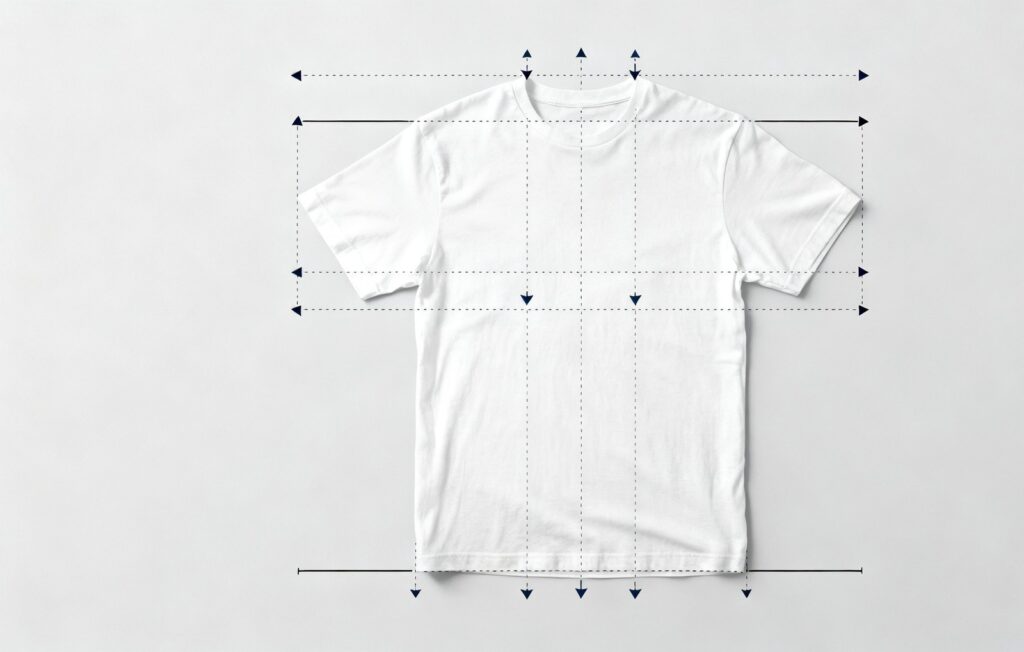
Use this chart as your baseline for standard adult unisex t-shirts. All measurements are in inches, taken flat and doubled (body width = chest circumference).
| Size | Chest (in) | Body Length (in) | Sleeve (in) | Shoulder (in) | Youth Chest (in) | Youth Length (in) |
|---|---|---|---|---|---|---|
| XS | 36 | 26.5 | 7.5 | 16 | 16 | 20.5 |
| S | 38 | 27.5 | 7.75 | 16.5 | 17 | 21.5 |
| M | 40 | 28.5 | 8 | 17 | 18 | 23 |
| L | 42 | 29.5 | 8.25 | 17.5 | 19 | 24.5 |
| XL | 44 | 30.5 | 8.5 | 18 | 20 | 26 |
| 2XL | 46 | 31.5 | 8.75 | 18.5 | 21 | 27.5 |
| 3XL | 48 | 32.5 | 9 | 19 | 22 | 29 |
| 4XL | 52 | 33.5 | 9.25 | 20 | — | — |
| 5XL | 56 | 34.5 | 9.5 | 21 | — | — |
Note: These are reference specs for a standard mid-weight unisex fit. Every supplier has slightly different grading. Always request the supplier’s own size chart and compare it to this one before you approve a bulk order.
How to Measure a T-Shirt Correctly
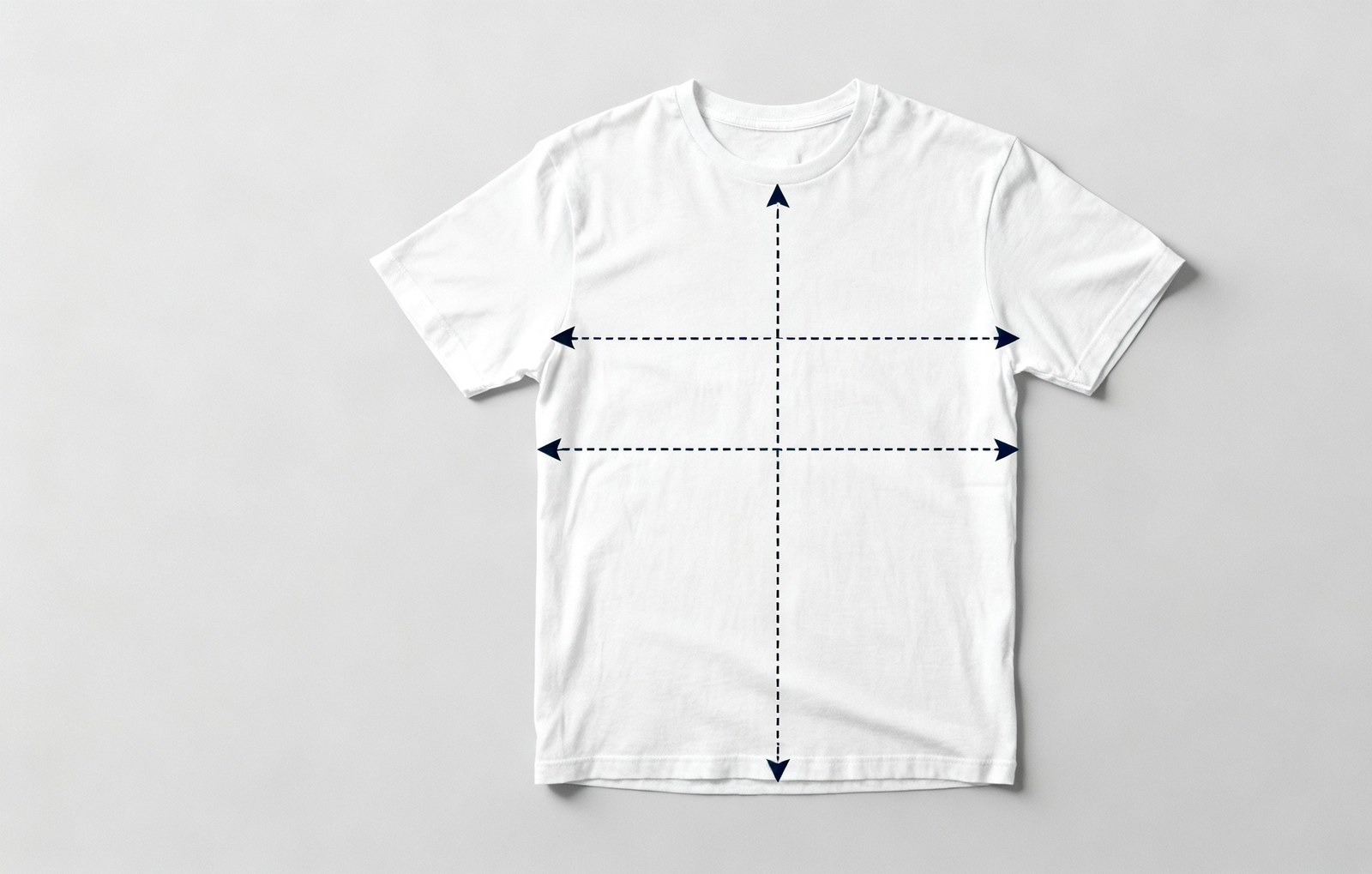
Measuring an existing shirt is more reliable than measuring a body, because it tells you the actual finished garment dimensions. Lay the shirt flat on a smooth, hard surface and smooth out the fabric first — do not stretch it.
Chest Width
Measure across the shirt from the left armpit seam to the right armpit seam, holding the tape under the arms and keeping it horizontal. This is the single-chest measurement, so double it to get the chest circumference. Do not measure across the chest while the shirt is laid flat from side seam to side seam, because that includes fabric that sits on the body differently and gives you a number that is too small once the garment is worn.
Body Length
Measure from the highest point of the shoulder seam straight down to the bottom hem. Keep the tape snug against the side seam and follow the curve of the hem rather than pulling it straight, because most modern tees have a slightly curved hem.
Sleeve Length
Measure from the center of the shoulder seam down to the bottom edge of the sleeve cuff. Always measure from the shoulder seam and not from the collar, because collar-to-cuff is a different measurement that will give you a longer and misleading number.
Shoulder Width
Measure across the top of the shirt from the outer edge of one shoulder seam to the outer edge of the other, following the seam line. This tells you how the garment will sit across the shoulders and whether the fit will be dropped or standard.
Measuring a Person Instead
If you do not have a reference shirt, measure the body with a soft tape held snug but not tight. Measure the chest at the fullest point, the waist at the narrowest, and the hip at the widest. Add roughly 2 to 3 inches (5–8 cm) of ease to the chest measurement for a standard fit, and 3 to 4 inches for a relaxed or oversized fit. For a full guide on what makes a good fit, see our article on choosing t-shirt fabric.
Unisex, Men’s, and Women’s Sizing: What Actually Differs
The word “unisex” on a supplier chart usually means the garment is cut to a single standard rather than being graded separately for men and women. That is good news for bulk ordering — you only need one size run — but it also means the fit is deliberately roomy for everyone.
| Fit type | Chest ease | Length ease | How it feels | Best for |
|---|---|---|---|---|
| Fitted / slim | +1 in | −1 in | Close to the body | Retail, fitness, fashion drops |
| Regular / standard | +2 in | 0 | Clean, not boxy | Corporate uniforms, general use |
| Relaxed | +3 in | +1 in | Easy, straight drape | Team orders, events |
| Oversized / drop-shoulder | +4 in | +2 in | Deliberately boxy | Streetwear, streetwear brands |
For company shirts and staff uniforms, a regular or relaxed fit is almost always the right call. A slim fit on a wide range of body types produces returns, and returns on a bulk order are expensive.
Youth and Kids Sizing
Youth sizing follows the same logic on a smaller scale, with the key difference that children grow during the production cycle. If you are ordering for a school or youth team, size up one full size for anything younger than eight years old, or plan on a reorder. Children’s apparel also carries stricter safety requirements — confirm the blanks and inks meet standards such as OEKO-TEX Standard 100 before ordering.
How Fabric Weight (GSM) Changes the Fit
This is the detail most size charts leave out, and it is where bulk orders most often go wrong. The same nominal size from the same supplier can fit very differently at 180 GSM and 240 GSM, because heavier knits are often drafted wider and longer, and some suppliers add shrink allowance on top of that.
| Fabric weight | How it fits | Sizing adjustment | Example |
|---|---|---|---|
| 140–160 GSM | Thin, drapey, slightly see-through | Size down for a standard fit | 150 GSM cotton |
| 180–200 GSM | Standard everyday weight | Size as charted | 200 GSM cotton |
| 220–240 GSM | Substantial, structured, boxier | Size down one for a closer fit | 240 GSM cotton |
| 260–300 GSM | Heavyweight, vintage, stiff hand | Size down one, expect shrinkage | 300 GSM cotton |
For a deeper look at how weight affects the finished garment, read our heavyweight t-shirt GSM guide, plus our comparisons of 180 vs 200 GSM and 200 vs 240 GSM. If you are still working out the basics, what is GSM in t-shirts explains the measurement properly.
Sizing by Fabric Type
Beyond weight, the fibre itself changes how a size behaves on the body.
Cotton
Cotton shrinks in the wash, and untreated cotton can shrink 3–5% in the length. If your order will be washed regularly, either pre-shrink the blanks or size up one. Cotton t-shirts are the most predictable option for sizing and the safest default for bulk orders.
Polyester and Poly-Cotton Blends
Polyester is far more dimensionally stable than cotton and will not shrink the same way, but it does not breathe and can feel tighter. For poly-cotton blends you get the best of both: cotton hand-feel with good stability. Our guide to cotton vs polyester t-shirts covers the tradeoffs in more detail.
Washed and Enzyme-Treated Tees
Washed t-shirts are pre-shrunk and softened, which makes sizing more predictable, but the garment has been shrunk before it reaches you, so the finished dimensions sit below the original spec. Always ask for the post-wash measurements, not the pre-wash ones.
Lyocell and Premium Blends
Lyocell and similar regenerated cellulosic fibres have a natural drape that follows the body more closely than cotton. For fitted styles, size up. See cotton vs lyocell t-shirts for the full comparison, and our list of best fabrics for private label t-shirts.
How to Build a Size Run for a Bulk Order
The right size distribution depends on your audience, and getting it wrong means unused inventory. Here are the practical approaches.
Use Actual Body Data When You Have It
For company uniforms and staff orders, collect shirt sizes directly through a signup form or a Google Form that asks for size, height, and weight. Anonymize the data and give people the measurement guidance in our chart above rather than asking them to guess. This is the single most accurate method and it takes ten minutes.
Use a Standard Distribution When You Do Not
When you cannot collect data — for an event with open registration, a resale line, or a giveaway — use a conservative standard distribution and pull one size up.
| Size | S | M | L | XL | 2XL | 3XL+ |
|---|---|---|---|---|---|---|
| General / event | 10% | 25% | 30% | 20% | 10% | 5% |
| Corporate staff | 10% | 25% | 30% | 20% | 10% | 5% |
| Streetwear / brand | 5% | 15% | 30% | 30% | 15% | 5% |
| Youth team | 15% | 30% | 25% | 15% | 10% | 5% |
Then apply two rules that save you money on every order: size up once at 2XL and above for shrinkage, and keep 5–10% of extra units for replacements and late joiners. Our article on what MOQ to expect from a t-shirt manufacturer covers how minimums interact with extra units.
Common Sizing Mistakes That Cost Money
- Ordering S–XL only. In the US, a large share of adults wear 2XL or larger. Skipping the upper sizes creates either unhappy employees or a costly reorder.
- Using body measurements without adding ease. A 40-inch chest measurement on a 40-inch chart produces a shirt with zero breathing room, which feels tight and gets returned.
- Ignoring pre-shrink treatment. If the blanks are not pre-shrunk, every size needs to be ordered one up. Ask your supplier directly whether the blanks come pre-shrunk.
- Mixing sizes from different suppliers in one run. Grading standards differ. If you combine blanks from two factories, verify the chest and length specs match before committing to the full order.
- Skipping the sample. Order two to three samples in your actual production fabric before a large run. Our OEM apparel quality control checklist covers what else to verify on those samples.
- Not requesting the supplier size chart. Never order against a generic chart alone. Get the supplier’s graded chart in writing, compare it to your target specs, and confirm the measurement method (flat vs. doubled).
Frequently Asked Questions
What is a standard unisex t-shirt size chart?
The standard unisex chart runs XS to 5XL with a chest measurement from 36 to 56 inches, body length from 26.5 to 34.5 inches, and sleeve length from 7.5 to 9.5 inches. Unisex sizing is cut to one standard rather than graded separately for men and women, which simplifies bulk ordering considerably.
How do I measure a t-shirt for a size chart?
Lay the shirt flat on a hard surface, smooth it out without stretching, then measure chest width across the armpit seams and double it for circumference. Measure body length from the highest point of the shoulder seam to the hem, sleeve length from the shoulder seam to the cuff, and shoulder width seam to seam across the top.
Should I size up on heavier GSM t-shirts?
Generally yes, size down one if you want a closer fit on 220 GSM and above, because heavier knits are drafted roomier. At 260–300 GSM, also expect 3–5% shrinkage unless the blanks are pre-shrunk. Confirm the shrinkage rate with your supplier before ordering.
How do I pick sizes for a bulk order without individual data?
Use a standard size distribution such as 10% S, 25% M, 30% L, 20% XL, 10% 2XL, and 5% 3XL or larger, then pull one size up at the upper end and hold back 5–10% extra units. For company uniforms, collecting actual sizes through a signup form is far more accurate and still takes only ten minutes.
Do different brands use different size charts?
Yes, and the differences are meaningful. Two brands can both label a shirt “L” with chest widths of 42 and 45 inches respectively. This is why bulk apparel runs are graded by style rather than by size label, and why you should always order against one supplier’s chart for the entire run. Our guide on how t-shirt manufacturing actually works explains why grading works this way.
How much does sizing affect the final cost?
Not much, if you get it right. The cost driver is the total quantity and the garment, not the size mix. But a wrong size distribution means excess inventory in one size and a shortage in another, and reordering to fix it costs more than the original order. Get the distribution right on the first run.
Should I order organic or GOTS-certified t-shirts in a specific size?
Organic and GOTS-certified blanks are graded very similarly to conventional ones, so the same charts apply. The one thing to confirm is pre-shrink treatment, since certification requirements can affect which finishing processes are used. GOTS certification details are covered by the Global Organic Textile Standard, and we list the standards we work with on our quality certifications page.
Conclusion: Get the Size Chart Before the Garment
Sizing is the cheapest part of a bulk order to get right and the most expensive part to get wrong. The practical sequence is straightforward.
- Decide the fit type that matches your use case — regular for uniforms, relaxed for teams, oversized for streetwear.
- Choose the fabric and weight first, because GSM and fibre change the fit more than the size label does.
- Request the supplier’s graded size chart in writing, along with the measurement method and the pre-shrink treatment.
- Collect real sizes where you can, and fall back to a standard distribution where you cannot.
- Order samples in the production fabric, measure them against the chart, and approve the run.
Ready to move from sizing to ordering? Read our complete guide to how to order custom t-shirts in bulk, or browse our wholesale blank apparel range to pick your garment. For pricing, see how much it costs to manufacture t-shirts. When you are ready, request a quote and we will match blanks to your size run, or contact us to talk through your distribution first.
